Monday, April 12, 2010

Mr. Wallace Reid


Since he has a birthday coming up, I figured I should crack out some info about Wally Reid. I feel like I repeat this a lot, but that is one of the tragedies of the silent era...but, Wally is virtually forgotten about now. His short career and short life made him disappear into the history of Hollywood to be overshadowed by those who came after him. He was oh so dreamy and I wish there were more films of his available...but...alas...


Wallace Reid was born William Wallace Reid on April 15, 1891 in St. Louis Missouri. His parents, Hal and Bertha were involved in show business, traveling the vaudeville circuit. He appeared on stage along with his parents, but eventually he chose school over the theater. He was a star athlete and also excelled in music, learning to play the banjo, piano, drums, and violin.

It was his father Hal that actually told Wally that he should pursue the new medium of film. Hal actually played a part in the film industry as well, acting, writing and directing films. Wally made his film debut in 1910.


Wally was more interested in directing film rather than starring in it, but those at the studio had a different idea. The studio wanted to capitalize on Wally's good looks and great body (ooh la la) and make him into a screen idol. He had a chance to work alongside with the silent era's elite leading ladies such as Gloria Swanson and Lillian Gish.

He had roles in both of D.W. Griffith's epics, Birth of a Nation and Intolerance. Although he was more famous for his roles as a daring race car driver in over six films.


In 1919, while making the film Valley of the Giants, Wally injured his back in a train wreck. He was given morphine so that he could continue on with filming. This was the beginning of his downward spiral because he soon became addicted. He kept working at a frantic pace to keep up with his very busy filming schedule. This did not help matters.

His health kept getting worse and worse until he finally contracted the flu and went into a coma. He never regained consciousness, and died on January 18, 1923 in Los Angeles. He was only 31.


Wally was interred at Forest Lawn in Glendale.

He was only married once, to actress Dorothy Davenport. They had one son, Wallace Reid Jr. and an adopted daughter, Betty. After his death, Dorothy travelled the country with the film Human Wreckage and discussed the dangers of drugs.

Wally and Dorothy Davenport

"The terrible shock of his death shattered the public's image of him, and almost shattered Hollywood." ~ Cecil B. DeMille on his friend Wallace Reid

Sunday, April 11, 2010

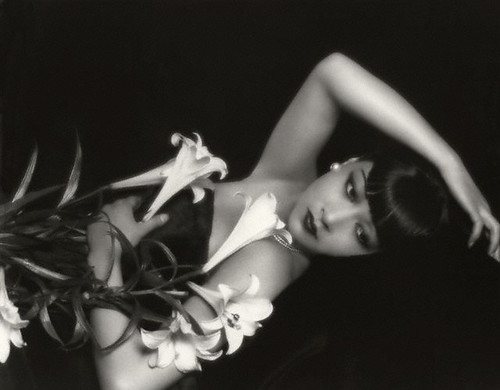
Miss Anna May Wong


The lovely Anna May Wong. Such a beautiful woman. She also had that look in the eye that made you think that she could probably take you down with one shot. But, that's sexy, so we love it! Just like Josephine Baker, I am using Anna May as the subject of a paper I am writing for my Minority Women in the U.S. class. During the silent era when it was just about the virginal Gish or the flapper Bow, Anna May stood out as the first Asian American movie star. I first saw her in Peter Pan, and she did a wonderful job. (That is a really great movie by the way, full of great stars. Check it out!)


Anna May Wong was born Wong Liu Tsong on January 3, 1905 in Los Angeles, California. She was the second of seven children born to Wong Sam Sing and Lee Gon Toy. She had four brothers: Richard, James, Frank, and Roger. And two sisters: Lulu and Mary. (Her mother died in 1931 after getting hit by a car).

She attended a public school at first, but after she was the target of racial threats, her parents enrolled her in a Presbyterian school where she learned English. She also attended Chinese language school after school and on the weekends.


During her childhood she became very interested in the new media of film. Films were being shot around her neighborhood, and she went to the local Nickelodeon to view the newest flicker. She began begging filmmakers for roles in films, earning her the nickname of "C.C.C." (Curious Chinese Child). When she was 11, she chose her stage name Anna May Wong.

Her father was not happy about her choice of career, but it was actually a friend of his that got Anna May her first screen appearance as an extra in 1919. She dropped out of school in 1921 to fully pursue a career in acting.

She kept making appearances in films but studios wouldn't place her in a starring role because of her ethnicity. There was actually a law in affect that prevented actors from kissing if the other was in "yellow face." And since there was only one leading actor at the time who was Asian (Sessue Hayakawa), she couldn't star in a picture.


She finally made a big splash by appearing in the 1924 film The Thief of Baghdad with Douglas Fairbanks. She played the role of a stereotypical "Dragon Lady." This was one of the two options that was open for her to play. It was either the deadly, sexy "Dragon Lady" or the innocent, submissive "Lotus Flower."

Anna May began feeling annoyed at the restrictions films were causing her, so she began touring on the vaudeville circuit. The tour didn't go as well as she thought it would, so she had to return to acting in films.


In 1926, Anna May, along with Norma Talmadge, attended the groundbreaking of Grauman's Chinese Theatre. Norma's footprints and autograph were immortalized in cement in front of the theatre after she accidentally stepped in the wet cement. Anna May was never asked to do this, even though she helped place some of the first rivets in the new theatre.

Just like Josephine Baker, Anna May moved to Europe where she found better success. It was here she befriended director Leni Reifenstahl. This close friendship, along with one she had with Marlene Dietrich, led to rumors that Anna May was a lesbian. The two actresses provocative scenes in the film Shanghai Express only fueled the rumors, but the relationship was never confirmed.


In 1930, she returned to Hollywood after having success in both German and English films overseas. When she heard that MGM was looking to do a film based on the book The Good Earth by Pearl S. Buck, she was aching for the female lead of O-lan. The studio couldn't cast her because her leading man would be Paul Muni, an American...who she could not kiss on screen. Also, the Chinese government was strongly against her being cast because they felt she did not represent China in a good light. The role of O-lan was eventually given to Luise Rainer, who won an Academy Award for her role. Anna May was offered a small part in the film, but she refused. Her younger sister Mary Liu Heung Wong did appear in it though. (Sadly, Mary hung herself three years later at age 30).

She appeared in films for years up until she died. They were mostly B-films and ones made for poverty row studios though. She was scheduled to appear in the film Flower Drum Song but had to decline due to failing health.


Anna May Wong died on February 2, 1961 of a heart attack in Santa Monica, California. She was interred with her mother at the Rosedale Cemetery in Los Angeles. For years the tombstone only contained the name of her mother, until 2008 when fans raised funds to buy her a proper headstone.

She never married and never had any children.

I absolutely love that she signed her autograph as "Orientally yours."


"I'm Anna May Wong. I come from old Hong Kong. But now I'm a Hollywood star." ~ Anna May Wong


Saturday, April 10, 2010

Miss Josephine Baker


For one of my classes, I am writing a paper that deals with minority women in the silent film era. The two ladies I chose to write about were Josephine Baker and Anna May Wong (whose bio will follow this one). So, I figure I would get my brain really working by writing about them on here before I write a somewhat boring analysis paper.

In my opinion, Josephine had one of the prettiest smiles. Her whole face just lit up when she smiled, and it made her look so beautiful and adorable. She also had a big heart and she deserves to be remembered for not only that, but for her acting and her singing talents.


Josephine Baker was born Freda Josephine McDonald on June 3, 1906 in St. Louis, Missouri. Her mother was Carrie McDonald, and her father was cited as being Eddi Carson, although it is up in the air whether or not that is correct.

At age 12, she dropped out of school and lived on the streets. She danced on street corners for money, and three years later was finally discovered by a recruit for the St. Louis Chorus vaudeville show. Soon after, she headed to New York. Her role on the Broadway stage was that of the last girl in the chorus line. It was her "job" to dance like she didn't know the steps and be the comic relief. At the encore of the show, she would dance a very intricate dance to prove that she really did know what she was doing.


In 1925, she went to Paris and became famous for her exotic dances and for appearing on the stage almost nude. Her most famous dance was done while she was wearing a skirt made of stringed together bananas. (Love it!) She also loved wearing sequins, feathers, and diamonds, and even dancing on stage with her pet cheetah.

Josephine starred in only 3 films, and they were films that were mostly only popular in Europe. I have only seen 1934's Zouzou and 1935's Princesse Tam Tam, and they are both very cute.

Around this time, she also had a hit song, "J'ai deux amours" and became somewhat of a muse for such notables as F. Scott Fitzgerald, Langston Hughes, and Christian Dior.


Unfortunately, Josephine didn't reach the heights of stardom in the U.S. as she did over in Europe. She received bad reviews and was eventually replaced in the Ziegfeld Follies. It wasn't until 1973 when she performed at Carnegie Hall that she received the recognition she deserved.

She eventually became a French citizen in 1937. She was so loyal to her new country, that she even offered to be a spy against the Nazis. She volunteered to offer information she overheard at parties and other social gatherings, and because of her status, she could attend some pretty elite parties. She also smuggled messages in invisible ink on her sheet music. She loved helping the war effort in other ways, such as sending Christmas presents to the soldiers.

Along with patriotism, Josephine was also very supportive of the Civil Rights Movement. Her biggest way to slap racism in the face was to adopt 12 children from different countries...way before Angelina Jolie. Her "Rainbow Tribe" consisted of sons: Janot (Korea), Akio (Japan), Luis (Columbia), Jari (Finland), Jean-Claude (Canada), Moise (France), Brahim (Algeria), Koffi (Ivory Coast), Mara (Venezuela), Noel (France). And daughters: Marianne (France) and Stellina (Morocco). Josephine did give birth once, but the baby was stillborn. This tragedy resulted in a hysterectomy in 1941.


She refused to perform for segregated audiences and caused a stir when she charged The Stork Club with racism when they refused to serve her. Actress Grace Kelly was there at the time and also vowed never to return to the club. The two became good friends after this incident. (When Josephine was falling on hard times financially, Grace helped her friend out).

She worked with the NAACP, and was asked after MLK's assassination, by his widow, to head the Civil Rights Movement. Josephine declined, saying that her children were too young and needed her more.

 
Josephine was married 4 times. First was William Howard Baker from 1920 to 1923. Next was Jean Lion from 1937 to 1938. Then Joe Bouillon from 1947 to 1957. And finally, Robert Brady from 1973 until her death. She was also said to have once been married to her manager, "Count" Pepito di Abatino.

There was/is rumors that Josephine was a bisexual. Her son Jean-Claude discusses it in a book about his mother, but that is the only kind of confirmation.


Josephine died on April 12, 1975 of a cerebral hemorrhage. A few days earlier, she had performed a stellar revue for an audience that included such luminaries as Sophia Loren, Mick Jagger, Liza Minnelli, and Diana Ross.

She was interred at the Cimetiere de Monaco in Monte Carlo. She was the first American women to receive full French military honors at her funeral.

There is a story that she once had a rejected lover kill himself at her feet.

Her favorite food was spaghetti. In case you were dying to know.


"I love performing. I shall perform until the the day I die." ~ Josephine Baker

Sunday, April 4, 2010

Miss Florence Lawrence


Hollywood's first movie star. Why don't more people remember Florence Lawrence? She is more forgotten today than even Olive Thomas or Jeanne Eagels. I had a chance to visit her grave last year. It was all alone next to a water pump house. But, the epitaph on her grave was so powerful that it made her stand out even more. "The first movie star." I took this picture, and I loved how the sun shined right on the word "first." It helped make the point about how special she was.


I look forward to visiting her again in May.


Florence Lawrence was born Florence Annie Bridgwood on January 2, 1886 in Hamilton, Ontario, Canada. Her parents were George and Charlotte Bridgwood, and she had two older brothers. Her mother was a vaudeville actress under the name of Lotta Lawrence. At age four, Florence took her mother's stage last name as her own surname. At age 12, her father passed away, and she and her family moved to Buffalo, New York.

After high school, she joined her mother's stage company, but it soon disbanded. In 1906, she and her mother moved to New York City. She made her film debut that same year.

Along with acting in film, Florence also appeared on stage. She toured for a year in a stage production of Seminary Girls. After the tour, she decided not to "live the gypsy life" anymore and focused wholly on her film work.

One of the main reasons Florence got hired so quickly for films was the fact that she was an excellent equestrian. In 1908, due to this skill, she appeared in 11 films in just 5 months.


D.W. Griffith was on the hunt for an actress to star in a film he was directing at the Biograph Studios. The role was going to go to another Florence, Florence Turner, but Miss Florence Lawrence managed to persuade Griffith and the film's leading man, Harry Solter to give her the role.

Her part in the film was a success and led to her being cast in more than 60 other films directed by Griffith.

At that time, film stars names were not made public. But fans started writing to Biograph asking about the girl they had seen very frequently in the pictures. Instead of releasing Florence's name, they simply started referring to her as "The Biograph Girl."


Florence began demanding to be paid by the week rather than by day, which started to anger the studio. When she began looking for work at Essanay Studios, they reported it to Biograph, who promptly fired her. She then joined with the Independent Moving Picture Company of America, or IMP. They were the ones who put her name on the marquee for the first time, making her the first star to be known by their real name. IMP founder Carl Laemmle got the publicity train going by starting a rumor at their new star had been killed in a street car accident. (Umm...nice one Carl?) They later printed out ads saying that Florence was indeed alive and well and was appearing in an upcoming film! Boom! The star system had arrived!

She bounced from studio to studio making film after film. She eventually realized her dream of buying an estate in New Jersey and gardening roses. She soon announced her wish to retire in 1912.


In 1915 though, she had to return to work again. While filming on of these films, she suffered singed hair, burns, and injuries from a fall due to a stage fire. This trauma sent Florence into shock. Even worse...the studio refused to pay her medical bills. She had to take time off to recover from her injuries. She never achieved the stardom she was accustomed to again.

She tried to go back to work in 1916, but she it was too stressful for her. She ended up being paralyzed for four months. She was diagnosed with a rare bone marrow disease, myelofibrosis. When she returned to the screen again in 1921, no one really remembered her.

Like others at that time, she lost most of her money in the stock market crash in 1929. She made a few appearances in films in 1936, but it only paid a small amount of money.


Florence Lawrence died on December 27, 1938. She was found unconscious in her Hollywood apartment after ingesting ant paste. She was rushed to the hospital, but died a few hours later. She was interred in an unmarked grave at Hollywood Forever Cemetery. It wasn't until 1991 that she received a proper grave marker. Actor Roddy McDowall purchased one for her, adding to her name and dates, "Biograph Girl and the first movie star." (I just love Roddy!)


Florence was married three times. First, to her costar Harry Solter from 1908 until his death in 1920. Then Charles Woodring from 1921 to 1932. And finally to Henry Bolton in 1932, but the marriage only lasted 5 months. She never had children.

Florence has been credited with being the inventor of the first turn and brake signal. But, she did not patent the invention, and others jumped on it and succeeded in getting it patented.

This is a very cute short featuring Florence. It is about those big ole hats ladies used to wear to the flickers.


Friday, April 2, 2010

Mr. Ramon Novarro


Aww! I just love Ramon Novarro. I saw him in The Student Prince in Old Heidelberg a few years ago, and just melted. He was just so lovely and endearing, how could you not love him?! This charming man did not deserve the horrible end he met with. Murdered by two brothers...I really hate people sometimes I swear...


Ramon Novarro was born Jose Ramon Gil Samaniego on February 6, 1899 in Durango, Mexico to M.N. and Elenor Samaniego. He had three sisters: Carmen, Luz, and Lenore. And four brothers: Mariano, Eduardo, Jose, and Antonio. At around age 14, he moved with his family to Los Angeles to escape the Mexican Revolution. He made his film debut a few years later in 1917.

His most famous film was 1925's Ben-Hur. It was pretty explosive due to the revealing costumes and helped make Ramon a star.

Other movies of note films that Ramon appeared in include: Scaramouche (1923), The Student Prince in Old Heidelburg (1927), and Mata Hari (1931).

After Rudolph Valentino died in 1926, Ramon became Hollywood's top Latin actor. (There wasn't any conflicts between the two actors, they were actually good friends). (...maybe more? Who knows?!)


In 1935, his contract was up at MGM and the studio decided not to renew it. He continued to act in films and even appeared on a few television shows. Even though he was not acting as much, he still maintained a pretty comfortable lifestyle due to his investments in real estate.

Ramon never married, although Louis B. Mayer once tried to get him interested in a "lavender marriage." Ramon was in fact gay, which caused him inner turmoil because of his conflicting religious beliefs. This also led him to become fond of the bottle. He was linked to a few men. The one who stands out is his own publicist, Herbert Rowe.

On October 30, 1968, Ramon called an escort agency and asked for some...well, male company. His call was answered by two brothers, Paul and Tom Ferguson. The boys (only 22 and 17) thought that there must be money stashed around the house and began torturing Ramon to find out where it was hidden. All they found was $20. Ramon Novarro died of asphyxiation from choking on his own blood. The two assholes were arrested and sentenced to long term prison sentences, but were released soon after. A little while later, they were arrested again for a different crime and were put back in prison...where they remain.

Ramon Novarro was interred at the Calvary Cemetery in Los Angeles.


He was the second cousin of actress Dolores del Rio.

He got his stage last name of Novarro from his good friend Gabriel Navarro. A typo made by a secretary changed the spelling from "A" to "O." Gabriel Navarro is the grandfather of Dave Navarro. (Pretty cool, eh?)


"The leading men of silent films were Adonises and Apollos." ~ Ramon Novarro

Thursday, April 1, 2010

Miss Pola Negri


For me, I tend to put Pola Negri in the same category as Alla Nazimova. To me, they are the exotic, out there, over the top divas of the silent screen. Which, don't get me wrong, is not a bad thing, its just how I picture these ladies. I read Pola's autobiography a few years back and she certainly painted an interesting picture. What is true and what is just from Pola's own imagination has been somewhat strained between fact and fiction. But, her outlandishness just makes her absolutely fabulous! Another lady that belongs in the silent era.


Pola Negri was born Barbara Apolonia Chalupiec on January 3, 1897 in Lipno, Poland. Her mother ended up having to raise her daughter on her own, after her husband was arrested by the Russian police and sent to Siberia. They lived in poverty throughout her childhood and eventually moved to Warsaw. Here, Pola took dancing lessons, but had to stop when she was stricken with tuberculosis.

She soon became a popular stage actress in her native country. She made her film debut in 1914. Soon after, she began using the stage name of Pola Negri.

In 1917, she moved to Berlin to continue her acting career. Soon after, in 1922, she was invited to go to Hollywood to sign a film contract.


Pola had a very exotic look, so she tended to be cast in vamp roles. Some of her films included: Forbidden Paradise (1924), Barbed Wire (1927), and The Way of Lost Souls (1929).

Not all of the interest in Pola was in her screen work. People also began to read about her off screen romances. Her most famous beaus were Charlie Chaplin, who she was briefly engaged to, and Rudolph Valentino. Although, the relationship with Valentino really came to life after Rudy died. Pola was seen at his funeral swooning repeatedly, spelled out her name in flowers on his coffin, and telling anyone who would listen that she and Valentino were engaged to be married. She said he was the love of her life and kept his picture by her bed. Many of Valentino's friends deny that the two were engaged and that she was using all of this for publicity purposes. But friends of hers, fellow actresses (like Mary Pickford), and even Valentino's brother Albert defended Pola. (Personally...I don't know whether or not they were engaged...but did Pola milk the publicity? Yeah, just a little bit).


Pola managed to get two men to the altar. She first married Count Eugene Dambski in 1921 and divorced him a year later. She then married Serge Mdivani in 1927. He claimed to be a Georgian prince, but who knows. His brother, David was married to Mae Murray for a time. Pola and Mdivani lost their money in the stock market crash, and then divorced in 1931. She never had children.

Because of her heavy Polish accent, she was not successful in the talkies. During this time, a rumor circulated that Pola was having an affair with Adolf Hitler. This started after Hitler reported called her his favorite actress. She went to Poland to help with the war effort. After the Nazi party stated that Pola had Jewish ancestry, she fled Poland and Germany and went to France.

Pola was one of the actresses who was approached by Billy Wilder to play the role of Norma Desmond in Sunset Blvd. She apparently threw a fit and scoffed at the idea of being cast as a has-been.

Moon-Spinners in 1964 was her final film role. She still maintained her diva like behavior after she quit the movies, ironically, mimicking the role of Norma Desmond, the role she turned down.


Pola Negri died on August 1, 1987 on pneumonia. She also apparently was suffering from a brain tumor, which she had failed to treat. She was interred in Calvary Cemetery in Los Angeles.

It was rumored that Pola had affairs with Mercedes de Acosta and Milton Berle. Mercedes claimed this in her autobiography, but there is no other proof than this. Berle made these claims of various radio shows, but then added that the women were dead, so they couldn't disagree.

And, is it just me...or does Pola have a lot of face going on?


"I consider my work great, as I am a great artist." ~ Pola Negri

Miss Martha Mansfield


Such a pretty lady, and such a tragic ending. I have already come to the conclusion that that is the reason I am drawn to a lot of these stars. As I have stated before (and if not, will state here and now) I am a total death hag.


Martha Mansfield is another one of those silent stars that is not remembered anymore. I think if she is remembered, it is either for her death, or for her role in Dr. Jekyll and Mr. Hyde with John Barrymore. I had a chance to a screening of the film last October at the Redford Theatre. It was an amazing movie and a great night! Also, the fact that photographer Alfred Cheney Johnston took many, many pictures of Martha will help to keep her face around for years to come.


Martha Mansfield was born Martha Ehrlich on July 14, 1899 in Mansfield, Ohio. She was raised in New York by her mother after her father left the family.

She began showing an interest in performing and by age 18, she was a regular performer on stage. She eventually made her way to the Ziegfeld Follies stage. (I always love the starlets rise through the Follies...so jealous!) She wasn't a huge star in the Follies, but famed Ziegfeld photographer, Alfred Cheney Johnston obviously had a favorite. He loved to photograph her.


Martha soon made her way to California and began to appear in movies. Her most famous performance was Dr. Jekyll and Mr. Hyde in 1920. She appeared in over 30 movies.

On November 30, 1923, Martha was in Texas filming her next movie, The Warrens of Virginia. During a break in filming, a cast member tossed a match and it landed on Martha's period costume. The costume immediately went up in flames. Leading man, Wilfred Lytell, her leading man in the movie, threw his overcoat on top of Martha, saving her face and neck from the flames. Those helping her remove the dress received terrible burns on their hands, but they did succeed in putting out the flames. Nevertheless, Martha was left with burns all over her body.


She was taken to a hospital in San Antonio where she died less than 24 hours later. She was only 24 years old. Her body was flown back to New York City where a funeral was held and she was interred at the Woodlawn Cemetery in The Bronx.

And...as usual...few of her films survive. I have only seen one that is available for viewing.

Martha and John Barrymore

The entire Dr. Jekyll and Mr. Hyde film with Barrymore and Mansfield is available online, in segments and its entirety. You can get there through Youtube, or rent it from your local library like I did! Always gotta rave about the libraries out there. :)