Monday, February 25, 2013

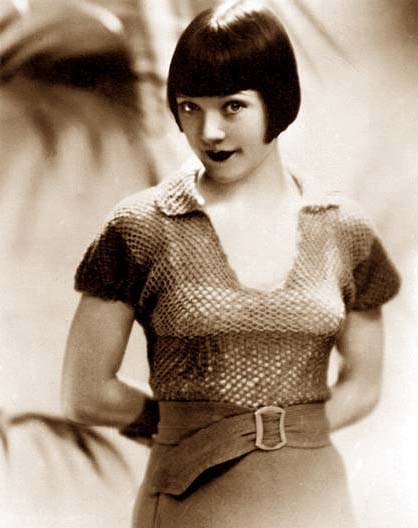
Miss Priscilla Bonner


Priscilla is one of only a handful of stars that I knew about before I became head over heels in love with silent films. I had first read about her in the book "What Ever Happened To..." by Richard Lamparski. There are quite a few books in this series and they are all great reads, very fun, so check them out if you can! I remember seeing the picture of Priscilla and her sister and reading the biography about her. It was only a short while later that I saw her playing Clara Bow's friend and roommate in It.


Priscilla Bonner was born on February 17, 1899 in Washington, D.C. She was the oldest child born to John and Mable Bonner, followed shortly after by brothers Albert and Perry, and sister, Marjorie. 

She made her film debut in 1920 in the MGM film Homer Comes Home. She was soon appearing in films with such big names as Lon Chaney and Colleen Moore. 

In 1925, Priscilla caused some waves in Hollywood when she sued Warner Bros. studio for having been fired from the film The Sea Beast. The film was a starring vehicle for John Barrymore and apparently he wanted Priscilla out and his new love, Dolores Costello, in the role instead. Amazingly enough (for that time) Priscilla won the case, and a nice big check to boot. She also received a written apology from Barrymore himself. I wonder what it said...

The trial didn't seem to slow her stride though because a few years later she was appearing in films with some lovely flapper stars like Olive Borden and Clara Bow. She made her last film appearance in 1929.


Priscilla Bonner passed away on February 21, 1996 in Los Angeles. 

She was buried at Forest Lawn in Hollywood Hills.

Priscilla was married twice. She married Allen Wynes Alexander in 1922, but divorced him in 1926. Her last husband was Dr. E Bertrand Woolfan in 1928. They remained married until his death in 1962. Neither marriage produced any children.

She never appeared in a talking picture. She chose her personal life over a movie career. Her film retirement came right after her marriage to Dr. Woolfan. I also read somewhere that she suffered an injury to her eye right around the same time and that also could have been why she chose to retire then.

Later in life, Priscilla and her sister Marjorie were both widowed and childless, so they decided to live together in an apartment. 

I should also note that Marjorie Bonner was also a film actress, but as she put it, "I lacked Priscilla's ambition. Acting was never a serious thing with me. I'm not a bit sorry. I never missed pictures." It seems that she was more famous for being the wife of author, Malcolm Lowry.
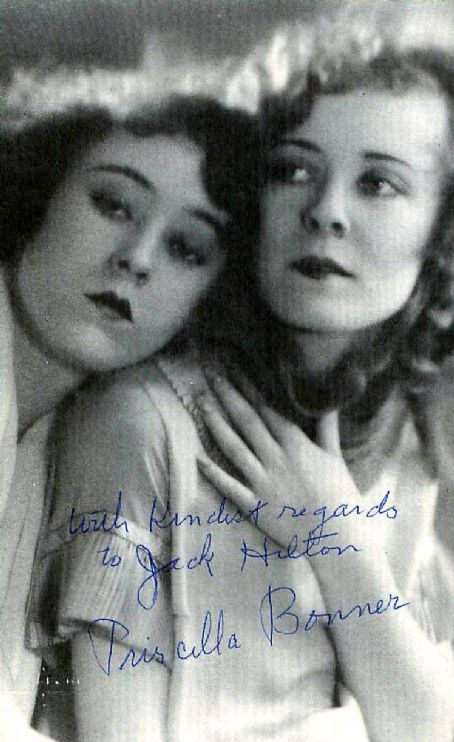
Marjorie and Priscilla Bonner

"My voice was fine (for talkies). But my husband did not want me in pictures. I never stopped missing it though. There's no substitute for that kind of attention. But I made an agreement and I kept it." ~~ Priscilla Bonner

Sunday, February 17, 2013

Miss Margarita Fischer


Time for another February birthday celebration!


Margarita Fischer was born on February 12, 1886 in Missouri Valley, Iowa. She was the second daughter born to John and Kate Ficher. Her sister, Katherine, was two years older than her.

Judging from a 1900 Census record, the family was either upper class or upper middle class because they had two servants. Also good to note that Margarita's name is listed as 'Margarette,' so that very well could be her birth name. I have also read conflicting accounts as to the way her last name was spelled at birth. Some places say she was just born 'Fischer,' while others claim she was born 'Ficher' and changed the spelling of it during WWII, or that she removed the 's' from her original name...I am not sure which account is the accurate one, sorry. I also wanted to mention that while I read she had an older sister named Katherine, I also found that she had a younger sister named, Dorothy who later worked as an actress under a different name. Again...no clue.

She began her acting career early, working on stage as a child for various touring companies. Her father soon realized how popular his lively daughter was and he set up the Margarita Fischer Stock Company which toured along the west coast for years.


While touring in her own stock company, she began appearing in films in the new film town of Hollywood.  Her first screen appearance was in a 1910 short called There, Little Girl, Don't Cry. For about five years, that was all she appeared in...shorts. It wasn't until 1915 that she appeared in her first feature called The Quest.

The character she is most well known for is that of Eliza in the 1927 version of Uncle Tom's Cabin. What was so interesting (well, now it is) is that Eliza is an African American slave girl and Margarita was white. Playing black face wasn't a big deal back in the early teens and twenties, it was actually a form of entertainment. Can you imagine her playing that role nowadays?

What is interesting is that her most famous picture was also her last picture. Her career may have been short in years, but not in work. She had appeared in over 90 films! The girl needed a breather. She kept busy in her personal life though and also worked and traveled for various charities.


Margarita Fischer passed away on March 11, 1975 in Encinitas, California.

She was interred at Forest Lawn in Glendale, California.

Margarita was only married once, in 1911 to actor and later director, Harry Pollard. They remained married until his death in 1934. The couple never had children.

In 1914, Photoplay magazine held a contest asking who the public thought was the most popular star in America, and Margarita was the winner! She beat out such big names like Mary Pickford and Mabel Normand!

She appeared nude in the 1916 film, The Pearl of Paradise.

According to a 1920 article from Photoplay, Margarita was only five feet tall, had copper colored hair, and gray eyes. She also enjoyed driving and working in her victory garden.


Her niece, Kathie Fischer, also appeared in some early silent films. Kathie later donated a bunch of silent film archival material to the Wichita State University to help keep the memory of her Aunt Margarita and Uncle Harry Pollard alive. Please visit the website here.

Thursday, February 7, 2013

Miss Anita Stewart


I need to take a break from fixing up older entries because it can be very time consuming and finicky and, yeah...need a break. So, what better way than to give my mind a workout and look at another beauty from the silent screen. Especially when said starlet was born 118 years ago today. So, let us meet the lovely Anita Stewart.


Anita Stewart was born Anna May Stewart on February 7, 1895 in Brooklyn, New York. Her mother's name was Marsha, and her father's name was William. She joined sister, Lucille, and brother, George.

While she was in high school, she began to get very interested in acting and it was around this age that she began work as an extra in various films at the Vitagraph studio. And as she got older, she became more recognizable and loved by the movie audiences.

Her first billed appearance was in 1911 in the film Prejudice of Pierre Marie. She was billed by her birth name at that time. She also appeared under the name 'Anita Stuart' at one point, but I am not sure if that was a choice on her part or an error on the film maker's part.  She started using the name 'Anita Stewart' around 1913.

One of her biggest hits was during her first year appearing on film which is quite extraordinary. She appeared in A Tale of Two Cities with such big names as Mabel Normand, Norma Talmadge, and John Bunny.


Anita finally left Vitagraph in 1918 and went to sign with the fairly new man in town, Louis B. Mayer. She did have some conditions though  to make her leave her home studio, she wanted her own production company. She got her way, which seems out of character for Mayer who was a bit of a control freak. There is also speculation that the real reason he got Anita was because he offered her an enormous amount of money...that sounds like the L.B. we know!

In the early 1920s she worked as the producer of some of her films including Rose o' the Sea in 1921 with Kate Lester. Her last silent film was in 1928's Sisters of Eve.

For some reason, Anita's talents didn't transfer well into the era of the talkies. The only talkie film she appeared in was a musical short in 1932 called The Hollywood Handicap (appropriate title, eh?). Alas, her glory days were behind her.


Anita Stewart passed away on May 4, 1961 in Los Angeles. Her sister, Lucille, found her unconcious at her home and called 911 to assist her in waking up Anita, but they were unsuccessful. It was later determined that she died of a heart attack.

She was interred at Forest Lawn in Glendale, California.

Anita was married twice. Her first marriage was in 1917 to a man named Rudolph Cameron, who was also an actor at Vitagraph. They two divorced in 1928. Her second marriage was to George Peabody Converse in 1929. They divorced in 1946. Neither marriage produced children.

Her sister, Lucille, was also an actress during the silent era. She was married to director Ralph Ince from 1921 to 1925. Their brother, George also worked as an actor, but after being confined to the bed after a drunken fight with then brother-in-law, Ralph Ince, his career went downhill. Anita helped take care of him until his death in 1945.

On April 14, 1941, Anita and her then husband, George Converse hosted the wedding of Jimmy Roosevelt, son of Franklin and Eleanor, to Romelle Schneider. Apparently the couple could not get married in a Catholic church because Jimmy Roosevelt had gone through a divorce the previous year.


"Dear Mr. Editor: Here I come with three good rousing cheers for Anita Stewart, Queen of the Movies, the best and most beautiful actress the screen possesses in my opinion...I have seen many very popular actresses, each very good in her own way, but give me Anita Stewart, my screen heroine, in preference to any of them. I will close wishing Anita the greatest success a movie fan can. I remain, Anita's Fifteen-year-old Admirer." ~~ The Toronto World - April 13, 1916 [this was from a number of letters written to the newspaper in response to their "World's Moving Picture Popularity Contest]

Monday, January 28, 2013

Miss Blanche Sweet


Another one of those cases where I thought I had written about Blanche Sweet but apparently was thinking about an alternate universe where I do everything in an organized, perfect manner. Oy vey!


Blanche Sweet was born Sarah Blanche Sweet on June 18, 1896 in Chicago, Illinois. From what I can find, it appears she was the only child of stage actors Gilbert and Cora Sweet. Now, I am not sure if something happened to her parents or if they were just constantly touring, but Blanche ended up being raised mostly by her grandmother whom she was named after, Blanche Alexander. Grandma wanted little Blanche to follow in the family footsteps and get into the acting business as well, so she put her on stage at only a few months old. She started touring with companies when she was four.

Around age 13, she signed with Biograph Studios and it only took a few months before she became a rival of Mary Pickford. The had quiet different screen personas though. While Mary was the typical Griffith heroine, demure and virginal, Blanche was gutsy and adventurous. Another rival of hers was Lillian Gish, who won the lead role in Birth of a Nation over Blanche. It was soon after this blow that she left Biograph and moved to Famous Players-Lasky...for way more money it should be noted.

The change in studios didn't hinder her career because she continued to be an audience favorite. And even better, the critics thought she was great too!

What did stall her career, like almost every silent actor's career, was the talkies. It wasn't that she had a bad voice, she had theatre training after all. But, times were changing and people's tastes were changing and they wanted to see new faces on the screen. Her last film appearance was in the 1930 movie, Show Girl in Hollywood with Alice White and Ford Sterling.


Blanche Sweet passed away on September 6, 1986 in New York City. She was cremated and her ashes were scattered at the Brooklyn Botanical Gardens. They were also cultivated into a special area with soil that hold beautiful lilies.

Blanche was married twice. Her first husband was director/producer, Marshall Neilan. The two began an affair during the 1920s while he was married to actress, Gertrude Bambrick. When Gertrude found out about the affair, she filed for divorce from Neilan. Blanche and he married in 1922, but divorced in 1929 because he just could not stop cheating.

Her second marriage was to actor Raymond Hackett in 1935. The marriage lasted until his death in 1958. Neither marriage resulted in children.


After she retired from the screen in 1930, she did some performances on stage and for radio and even worked at a department store for a bit. During the 1960s, she worked with film historians in studying not only her work, but the silent film era in general.

When she was touring and staying at hotels, she would check in using the name "Daphne Wayne."


"...and, you know, I haven't the faintest idea how many silent films I made. I couldn't begin to count them." ~~ Blanche Sweet

Sunday, January 27, 2013

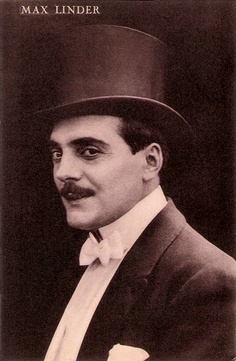
Mr. Max Linder

I have been meaning to do this post for awhile, but I am lazy. That is the only excuse I can think of. That and it has a sad ending and those are such downers, ya know?

Max Linder. One of the silent screen's first clowns. His work inspired many silent film comics that are remembered today, yet he is relatively unknown. But, I am here to put my name on the list of people who know who he is and are trying to make sure his work is recognized for being as wonderful as it was.


Max Linder was born Gabriel-Maximilien Leuville on December 16, 1883 in Caverne, France. His parents owned a vineyard and hoped that one day young Max and his elder brother, Maurice, would join in on the family business. Unfortunately for the Linder parents, neither son was interested in that route. Maurice became a well known rugby player and Max began to show a fondness for the theatre at a young age.

When he was around 16 years old, he enrolled in a prestigious acting school and was soon getting praises for his comedic abilities. He began acting in the bigger productions put on by the school, even doing some dramatic roles, which he was also showing a lot of talent in.

It was around 1905 that Max started acting in bit parts in movies, still maintaining a more successful career on the stage. Some of his roles were in the famed director, Georges Meilies' films.


Interestingly, his start as a star in films happening on a happy accident. While working for Pathe', he took over acting roles for their main star who moved to a different company. The character he was going to be playing was a fancy dressing, dapper gentleman in a silk top hat, cane, the whole works. The 'obstacles' his character faced usually centered around his trying to woo women and getting into mishaps while trying to do so. The character was simply referred to as "Max."

Max's first onscreen appearance as the dapper "Max" was in 1907's, The Skater's Debut.

The film was not popular with audiences, so Max decided to pack and go to Italy to see what was cooking there. And wouldn't ya know, the same 'happy accident' happened there when Max went from small roles to leading roles after replacing another actor. He would appear in several different roles, including the Max character, and the studio found that the dapper gentleman was becoming the audience favorite.


During the years of 1909 and 1910, Max became a big star. He was popular in Europe and over in the states. He even had a movie theater named after him in Paris!

In 1911, Max's career screeched to a halt after he was bedridden due to appendicitis. A few months later, he returned to working both behind and in front of the camera. He was writing scripts and directing and had complete control over his films and it worked out really well for him.


The following year, Max had just come back from a tour of Europe and was fully aware of just how popular he was with fans. He told Pathe' that he wanted a raise...he wanted a million. And believe it or not, the studio gave it to him. It seemed like they were happy to oblige their biggest moneymaker, but behind closed doors, they called him "The Napoleon of the Cinema."

When World War I began, Max was eager to join up and help defend his country, but he was found physically unfit for battle. So, he did his part for the war effort by entertaining the troops and making movies, including a patriotic film in 1914 called The Second of August.

Max had concurred Europe, but now the States wanted this famous French comedian. Essanay came knocking and wanted him to sign a contract with them. He accepted and moved to the US in 1916. For curious reasons, his films didn't fair as well in the US as they did overseas. The only film that was somewhat well liked was Max and his Taxi.

With his plans in the US not going the way he wanted, he returned to France and began to make feature length films, the first being The Little Cafe. The film was popular in Europe, but once again, did not do well over in the US. He kept trying though, even forming a production company in Hollywood. It was there he made one of his most well known pictures, Seven Years Bad Luck. But, what is considered great now was not seen as all that much back in 1921.

Charlie Chaplin and Max

It was shortly thereafter that he decided to hang up his silk top hat and do away with the dapper Max character.  He instead wanted to try and do a satire of a Douglas Fairbanks-esque persona. The film was The Three Must-Get-Theres and was hailed by Fairbanks himself and also by Linder's new friend, Charlie Chaplin. Once again, those persnickety US audiences didn't like it though.

Back to France it was, and another non-comedic film role that was hailed by critics but wasn't allowed to be released for a few years in the US and his home country due to copyright issues. I'm telling ya, his career arc must have resembled a roller coaster!

Not surprisingly, the back and forth of his career and other issues began to wear down on Max's psyche and he started to suffer from severe bouts of depression. It didn't help matters that he met and married a woman who clearly also had some mental issues. Max had known Helene "Jean" Peters since they were children and they finally married in 1923. They had a daughter named Maud Max "Josette" Linder a year later.

Why do I say his wife had emotional problems too? Well, because the couple had a suicide pact agreed upon the year their daughter was born. They made an attempt at it but were discovered and were revived. The second time around, they achieved success.


Max Linder passed away on October 31, 1925 alongside his wife, Jean. The couple had attended a performance at the theater earlier that evening, returned home, drank Veronal (a sleeping agent), and cut their wrists. No one knows why they had decided on the suicide pact.

They were buried at the St. Loubes Cimetiere in Saint-Loubes, France.

Maud Linder was only a baby when her parents killed themselves, so her care was taken over by Jean's parents. They raised her without telling her who her father was or what had really happened to her parents. It wasn't until she was around twenty years old that her grandparents finally told her how her parents died. They must have left out how famous her father was though because it wasn't til years later that she saw his name on a movie poster and saw that he had been quite a star. She started to devote her life to making sure her father and his work was remembered and even created two documentaries (one in 1963, the other in 1983) talking about his life and his movies. She also wrote a book about him in 1992. Incredibly, Maud is still alive today and lives in France.

Charlie Chaplin and Max

Charlie Chaplin became a great friend and admirer of Max. During his various stays in the US, Max and Charlie would go out on the town together and help each other with script writing. When Charlie read after his friend's suicide, he closed his studio for the day and dedicated his next picture to him, calling himself "Max's disciple."

He made around 500 films, but only some 80 titles have been known to survive.

"He calls me his teacher, but I have been the happy one, to take lessons from his school." ~~ Max Linder on Charlie Chaplin


"When we do a film, I tell my story to my actors; I explain how I want them to behave; we rehearse once; and we shoot." ~~ Max Linder

Wednesday, January 23, 2013

Around the world in silent days!

I am itching to go back to California and visit some old friends. And by old friends I am of course referring to my silent film friends: Buster, Rudy...etc. But, since I can't right now, I figured why not take a little trip around the world and check out some silent stars who graced the screen in other countries.

Marcella Albani
Born in Albano Laziale, Italy
Made films in Italy, Germany, Austria, France, and Czechoslovakia
Francesca Bertini
Born in Florence, Italy
In 1915 she was was making over $170,000 in pictures, beating Mary Pickford to the punch as the highest paid actress during that time. 

Lyda Borelli
Born in Rivarolo Ligure, Italy
Her son, Giorgio Cini Jr. was engaged to Merle Oberon, but sadly he died in a plane crash before they were wed. 

Elga Brink
Born in Waidmannslust, Germany
Appeared in films from 1922 through 1951
Maria Carmi
Born in Florence, Italy
Her and husband created the perfume company Prince Matchabelli
Patience Cooper
Born in Calcutta, India
Was one of the first stars of Bollywood 

Maria Corda
Born in Deva, Hungary
Was married to director Alexander Korda from 1919 til 1930

Leda Gys
Born in Rome, Italy
Her birth name was Giselda Lombardi. Her stage name was created by an Italian poet.
Lilian Harvey
Born in Hornsey, England
Helped people persecuted by the Nazis escape until she herself had to escape.

Maria Jacobini
Rome, Italy
Her sister, Diomira, was also an actress.
Vera Karalli
Born in Moscow, Russia
Was also a ballerina for the Bolshoi

Sumiko Kurishima
Born in Shibuya, Japan
Considered the first female Japanese movie star

Ruan Lingyu
Born in Shanghai, China
Also credited as Lingyu Ruan, she committed suicide at age 24 which made her an icon in the history of Chinese film.

Mia May
Born in Vienna, Austria
She didn't begin her film career until she was 34 years old. 

Raquel Meller
Born in Tarazona, Spain
Sarah Bernhardt once called her a genius.
Pina Menichelli
Born in Castroreale, Italy
She retired from the screen at age 34.

Karin Molander
Born in Vardinge, Sweden
Appeared in a film called Erotikon, about a professor obsessed with the sexual life of bugs...yeah...
Musidora
Born in Paris, France
Her real name was Jeanne Roques
Henny Porten
Born in Magdeburg, Germany
She, and her films were boycotted by the Nazi regime because she was married to a Jewish man.

Elena Sangro
Born in Vasto, Italy
Her birth name was Maria Antonietta Bartoli Avveduti 

Kinuyo Tanaka
Born in Yamaguchi, Japan
Was the first female Japanese director
Wanda Treumann
Born in Koclin, Poland
Disappeared off the map around 1922. It is assumed she died during WWII.

Olga Tschechowa
Born in Alexandropol, Armenia
Before she died at age 82, she ordered a class of champagne, toasted her granddaughter and said, "Life is beautiful!" What a way to go!

Truus Van Aalten
Born in Arnhem, Netherlands
When the Nazis came to power, she had to stop acting. When she refused to act in their propaganda films, she had to retire completely.

Hanni Weisse
Born in Chemnitz, Germany
Went AWOL after her last film in 1942. All that is known about her is that she died in 1967.